At 11:47 p.m. on a Tuesday, a marketing professional in Seoul is watching the countdown timer on a webinar registration page. The timer reads 13 minutes. The event itself isn't until Thursday. But the early-bird pricing expires at midnight — and the timer has been counting down every time she has visited this page over the past three days.
She registers. She isn't entirely sure why. The price difference is minor. She wasn't planning to this week. But something in those descending numbers, combined with a banner reading "Only 9 spots remaining," made the decision feel urgent in a way that overrode her initial indifference.
This is FOMO in action — not the casual social anxiety of missing a party, but a precisely engineered psychological response to the manufactured appearance of scarcity and urgency. And it is one of the most widely deployed, debated, and double-edged tools in the content creator's arsenal.
What Is FOMO?
Fear of Missing Out — the acronym was coined by marketing strategist Dan Herman in 1996 and popularized in academic literature by psychologists Andrew Przybylski and colleagues in 2013 — is defined as "a pervasive apprehension that others might be having rewarding experiences from which one is absent." It is characterized by a desire to stay continually connected with what others are doing.
FOMO is not a social media invention. Its evolutionary roots predate smartphones by hundreds of thousands of years. In ancestral environments, exclusion from group activities — hunting parties, food sharing, social alliances — had genuinely life-threatening consequences. The anxiety response to potential social exclusion is therefore deeply wired, and modern platform design has become extraordinarily skilled at triggering it in contexts where the actual stakes are minimal.
Leon Festinger's social comparison theory (1954) provides the conceptual foundation: humans evaluate their own worth and standing largely through comparison to others. When we perceive others as having access to experiences, information, or connections that we lack, the resulting dissonance creates motivational pressure to close the gap — to not miss out.
"FOMO is not a character flaw or a digital-age pathology. It is an adaptive anxiety response being hijacked by attention-economy design."
How Platforms Engineer FOMO
The most successful content platforms have built FOMO directly into their product architecture. This is not accidental; it is the result of deliberate, research-informed design decisions that optimize for one metric above all others: time on platform.
Disappearing Content
Instagram Stories, Snapchat, and BeReal all use ephemerality as a core engagement mechanic. Content that disappears after 24 hours creates a categorical urgency that permanent content cannot match — if you don't see it now, you never will. This single design choice transformed Instagram from a photo archive into a real-time social experience, dramatically increasing daily active usage. The anxiety of missing a Story is structurally identical to the anxiety of missing an event — and it recurs every 24 hours without fail.
Live Events and Real-Time Signals
YouTube Live, Twitch, Twitter Spaces, and LinkedIn Live all exploit the psychological premium audiences place on real-time participation. Being present "when it's happening" confers status and connection; watching the recording afterwards feels diminished by comparison. Platforms reinforce this by making live formats more visually prominent and algorithmically favored during the event window, then less so afterward.
Trending and Activity Signals
Trending tabs, "X people are watching this now," and real-time notification counts all communicate the same message: something is happening, other people are part of it, and you are currently outside the experience. The social proof component amplifies the FOMO signal — it is not merely that something exists, but that many people are engaging with it simultaneously.

The Psychology of Urgency in CTAs
Urgency is FOMO's transactional cousin. Where FOMO operates through social comparison ("others are having an experience I'm not"), urgency operates through loss aversion ("something valuable will no longer be available"). Both exploit the same neurological substrate — the anxiety of missing a limited opportunity — but urgency attaches that anxiety to a specific action with a specific deadline.
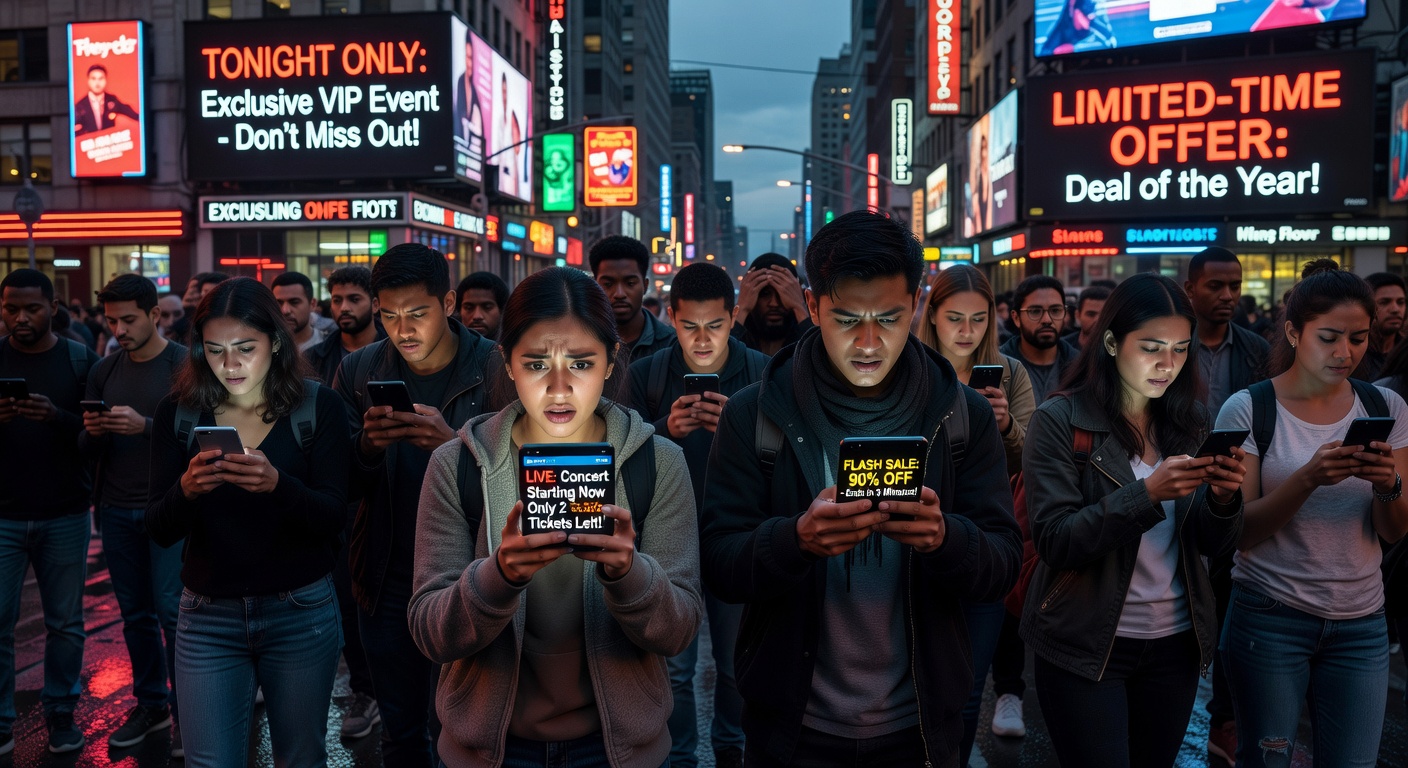
Urgency in content CTAs typically takes three forms. Time-based urgency uses countdown timers, deadline language ("offer ends tonight"), and temporal cues ("for the next 24 hours only"). Quantity-based urgency signals limited availability ("only 3 left," "fewer than 10 spots remaining"). Event-based urgency ties the opportunity to an unrepeatable moment ("this is only happening once").
Neurologically, urgency triggers the amygdala's threat-response system — the same mechanism activated by physical danger — and temporarily suppresses prefrontal cortex activity. This means urgency literally reduces the capacity for deliberate, analytical decision-making. Purchases made under urgency pressure are processed primarily by System 1 (fast, emotional) rather than System 2 (slow, analytical), which is precisely why they tend to be regretted at higher rates.
Urgency Tactics Commonly Used in Digital Content
- Countdown timers on landing pages and in email headers
- Limited-time discount codes with visible expiry
- "Doors close" language for course or community launches
- Real-time inventory or capacity indicators
- Flash sales with no advance notice, requiring immediate decision-making
- Early-bird pricing windows that reset upon return visits (manufactured urgency)
- Waitlist signups that imply future unavailability
Scarcity vs. Manufactured Scarcity
The ethical crux of FOMO and urgency marketing lies in the distinction between genuine scarcity and manufactured scarcity. Genuine scarcity exists when a product, service, or experience truly is limited — a live event with a physical venue, a coaching program with finite hours, a handcrafted good produced in small quantities. Manufactured scarcity artificially imposes limitation on something that is not actually scarce, to trigger the psychological response without the underlying reality.
The problem with manufactured scarcity is not that it is ineffective — it works, in the short term. The problem is that audiences increasingly detect it, and detection triggers a trust collapse that far outweighs any short-term conversion gain. A timer that resets on every visit, a "limited availability" claim attached to a digital download, a "last chance" email that is followed by three more "last chance" emails — these patterns are now widely recognized by digital-native audiences, and recognition produces not compliance but contempt.
Manufactured scarcity is also, in many jurisdictions, legally problematic. Consumer protection laws in the EU, UK, Australia, and increasingly in the United States specifically address false urgency and deceptive availability claims.
Using FOMO Ethically
This does not mean that urgency and scarcity signals have no place in ethical content strategy. It means that their use must be grounded in reality and oriented toward the audience's genuine interest.
Ethical urgency application starts with real deadlines and real limits. A workshop genuinely limited to 20 participants has genuine scarcity; it is appropriate and useful to communicate this. An online course that closes enrollment to maintain cohort quality has a real rationale; communicating the enrollment window serves the audience. Early-bird pricing that genuinely disappears at the deadline, without reappearing, is honest urgency communication.
Beyond the mechanics of scarcity, ethical FOMO engagement means treating your audience's anxiety as something to be respected, not exploited. The creator who builds a community around shared experience — where live events, early access, and real exclusivity are offered as genuine value to community members — activates belonging-FOMO rather than fear-FOMO. The desire to be part of something meaningful is a healthy motivator. The anxiety of being manipulated by false scarcity is not.
"The line between motivation and manipulation is not drawn by the technique used — it is drawn by the honesty of the premise and the genuine benefit to the audience."
The Backlash Against FOMO Marketing
Since approximately 2021, there has been a measurable and growing cultural backlash against FOMO-driven content design. The "slow content" movement, the rise of intentional social media use, and widespread coverage of platform design as addiction-adjacent have made audiences increasingly aware of and resistant to FOMO engineering.
This backlash has created a paradoxical opportunity for creators who choose transparency and restraint. Creators who explicitly acknowledge that they are not using manipulative urgency tactics, who offer flexible timelines, who are honest about product availability — increasingly earn a trust premium that translates to higher conversion rates without manufactured pressure.
Anti-FOMO positioning has become a genuine differentiator. Newsletter writers who promise a sustainable cadence rather than daily urgency, course creators who offer evergreen enrollment rather than launch-cycle panic, community builders who invest in depth of experience rather than breadth of FOMO — these creators are capturing an audience segment that has been burned by manufactured scarcity and is actively seeking trustworthy alternatives.
Digital Wellbeing Considerations
The content creator occupies an unusual position in the digital wellbeing debate: they are simultaneously potential contributors to and potential solutions for the anxiety ecosystems that platforms have built. FOMO-driven content consumption is associated in the research literature with increased anxiety, decreased life satisfaction, disrupted sleep, and reduced ability to be present in non-digital life.
Creators who are aware of these dynamics face genuine choices. Content that deliberately triggers FOMO for engagement gain contributes to these documented harms. Content that provides genuine value, fosters real community, and respects the audience's finite attention and emotional resources can be part of a healthier digital diet.
This is not an argument against the use of all urgency or scarcity — it is an argument for intentionality. Know why you are using these mechanisms, understand their psychological effects, be honest with yourself about whether the urgency you're communicating is real, and hold yourself accountable to the wellbeing of the audience whose attention you are asking for.
A Framework for Ethical Urgency and Scarcity
Before applying any urgency or FOMO mechanism in your content, consider the following questions:
- Is the scarcity real? Does the limitation actually exist, or is it manufactured to create pressure?
- Is the urgency honest? Will the deadline actually close, without exceptions or resets?
- Would full transparency preserve the mechanism? If your audience understood exactly what you were doing and why, would they still feel the urgency was reasonable?
- Does the urgency serve the audience's interests? Is there a genuine reason why acting now benefits them — or is the urgency purely in your interest?
- Could it cause harm? Are you targeting people who may be particularly susceptible to anxiety-driven decisions (financial stress, social insecurity)?
If you can answer these questions honestly and still proceed, urgency and scarcity can be legitimate tools. If the answers expose manipulation, consider the long-term cost to audience trust and your own integrity as a creator.