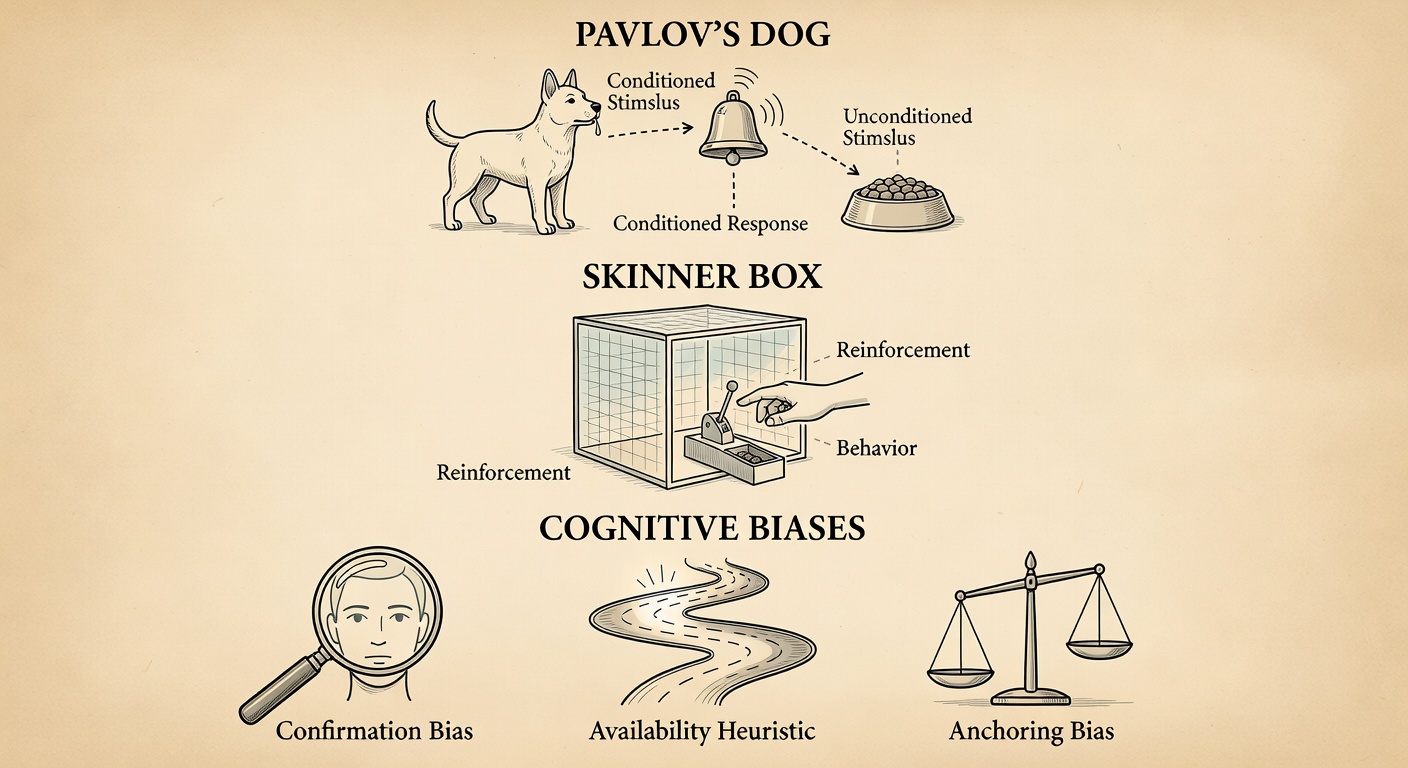
In 2002, Daniel Kahneman received the Nobel Prize in Economics for research that had nothing to do with money — at least not directly. His life's work, developed largely in collaboration with the late Amos Tversky, demonstrated that human judgment is systematically irrational in predictable, mappable ways. We do not make decisions by carefully weighing all available evidence. We take cognitive shortcuts — heuristics — that are usually good enough, and occasionally catastrophically wrong.

For content creators, this is not merely academic. These cognitive shortcuts determine whether a viewer clicks or scrolls, whether a reader trusts or dismisses, whether an audience shares or ignores. Understanding the architecture of human judgment is not an optional extra for the sophisticated content strategist. It is foundational knowledge.

System 1 vs. System 2 Thinking

Kahneman's most influential framework distinguishes between two modes of cognition. System 1 is fast, automatic, intuitive, and emotional — it operates below conscious awareness and makes most of our decisions. System 2 is slow, deliberate, analytical, and effortful — it is engaged when we consciously reason through a problem. Most content is processed almost entirely by System 1. Cognitive biases are the predictable patterns of System 1 error. Recognizing them allows creators to design for how audiences actually think, rather than how we assume they think.

"The human mind is not a logic machine that occasionally makes emotional errors. It is an emotional and social organ that occasionally engages in deliberate reasoning."

The 10 Biases

Bias 01

Confirmation Bias

What It Is The tendency to seek, interpret, and remember information in ways that confirm one's existing beliefs — while ignoring or discounting contradictory evidence. First systematically studied by psychologist Peter Wason in his 1960 rule discovery task.
In Content Consumption Audiences are far more likely to engage with, share, and remember content that validates their existing worldview. Content that challenges core beliefs tends to be dismissed, attacked, or ignored — regardless of its factual accuracy. This is why tribal content performs so reliably and why nuanced, perspective-shifting content faces an uphill battle.
Ethical Application Meet audiences where their beliefs are before gently introducing new perspectives. Framing challenges as "additions to" rather than "corrections of" existing beliefs reduces defensive rejection.
Bias 02

The Anchoring Effect

What It Is The disproportionate influence of the first piece of information encountered (the "anchor") on all subsequent judgments. Identified by Kahneman and Tversky in 1974, anchoring is remarkably robust — it affects experts as much as novices, and even obviously arbitrary anchors exert significant influence.
In Content Consumption The first number, claim, or framing a reader encounters in your content heavily influences how they evaluate all subsequent information. A headline that positions a product as "only $97" versus "$97" primes a different evaluative framework. The opening paragraph of an article anchors the entire piece's perceived credibility and value.
Ethical Application Use anchoring to set appropriate context — explaining the scale of a problem before your solution, or the typical cost of a mistake before your preventative content. Avoid using false anchors that misrepresent real-world context.
Bias 03

Social Proof

What It Is The tendency to look to others' behavior as information about the correct action in ambiguous situations. Theorized by Robert Cialdini and grounded in evolutionary logic — in environments where information is limited, the behavior of others is a useful proxy for ground truth.
In Content Consumption View counts, like counts, subscriber numbers, testimonials, and citations all function as social proof signals. Content that displays evidence of existing engagement performs better than identical content without those signals. Virality is partly self-fulfilling: once something is clearly popular, it becomes more likely to attract additional engagement.
Ethical Application Display genuine social proof and let it grow organically. Inflating metrics, purchasing fake engagement, or manufacturing false testimonials is deceptive and erodes long-term trust.
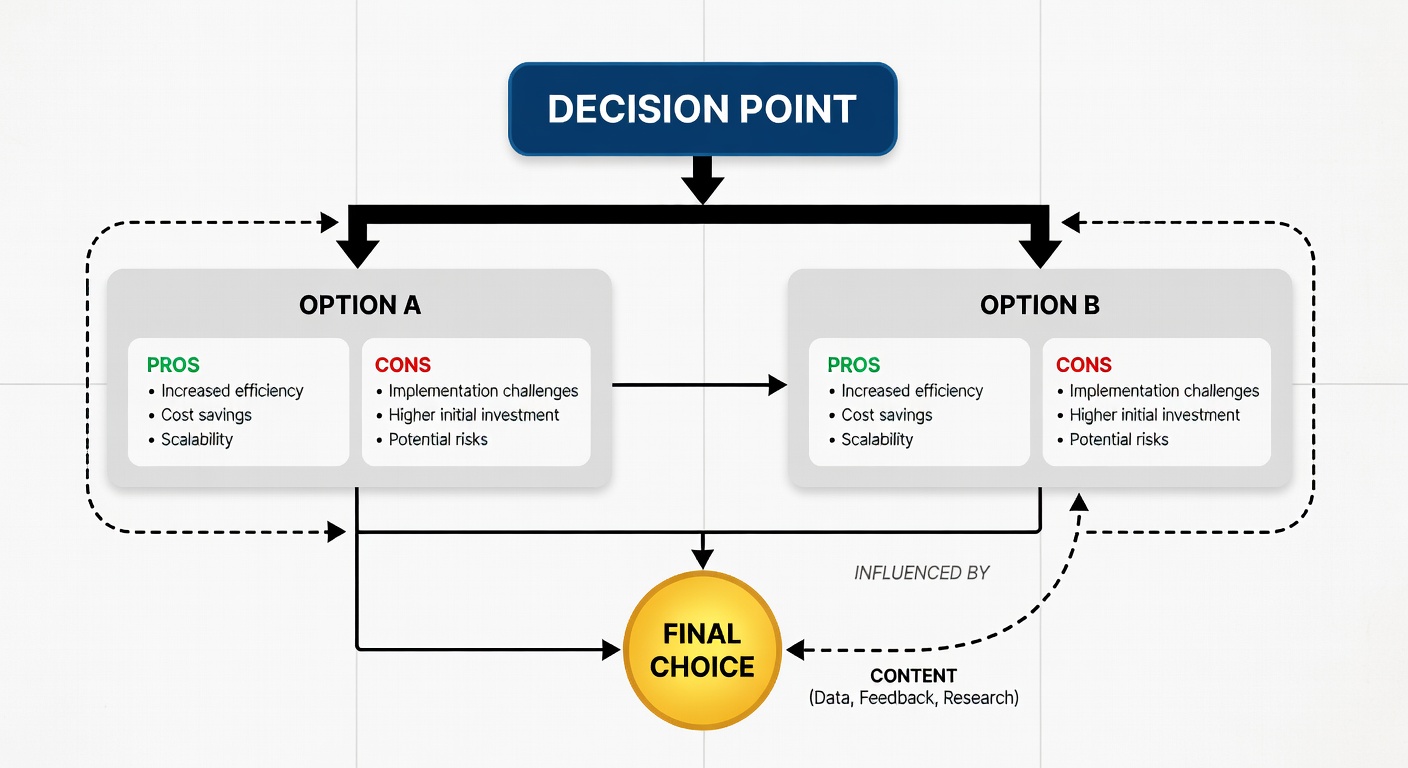
Decision Making Process
The decision-making process involves a complex interplay of cognitive, emotional, and social factors. Understanding this architecture allows content creators to design experiences that align with how decisions actually happen — rather than how we assume they do.
Bias 04

Scarcity Heuristic

What It Is The cognitive tendency to assign greater value to things that are rare, limited, or diminishing. Psychologist Stephen Worchel demonstrated in 1975 that cookies in a near-empty jar were rated as more desirable and of higher quality than identical cookies in a full jar.
In Content Consumption Content framed as exclusive, early-access, or temporarily available generates stronger engagement responses. Newsletters with a "members only" prefix, posts that acknowledge a limited window of relevance ("this method is working right now, but won't in six months"), and content positioned as insider knowledge all exploit scarcity signals.
Ethical Application Apply scarcity framing only when the scarcity is real. Manufactured scarcity that is revealed as artificial damages trust more severely than any engagement gain justifies.
Bias 05

Authority Bias

What It Is The tendency to attribute greater accuracy and credibility to the opinion of authority figures — regardless of the actual evidence. Dramatically demonstrated by Stanley Milgram's obedience studies and elaborated by Cialdini as one of the six principles of persuasion.
In Content Consumption Credentials, institutional affiliations, professional titles, and publication in recognized outlets all trigger the authority heuristic. "A Stanford study found..." carries far more persuasive weight than "a study found...", even when the study's methodology is identical. Expert endorsements and formal credentials in author bios measurably increase content credibility and sharing.
Ethical Application Display genuine credentials transparently. Misrepresenting expertise, fabricating academic affiliations, or misattributing research is a category of deception that ultimately destroys the audience trust that authority bias was meant to build.

"Cognitive biases are not flaws to be corrected in your audience — they are features of human cognition to be respected and, where ethical, thoughtfully engaged."

Bias 06

Mere Exposure Effect

What It Is The phenomenon whereby people develop a preference for things merely because they have been exposed to them repeatedly. First identified by Robert Zajonc in 1968, the mere exposure effect occurs even for stimuli that are processed below the threshold of conscious awareness.
In Content Consumption Consistent brand presence — the same visual style, voice, posting cadence, and thematic territory — builds familiarity that converts to preference and trust over time. The creator who shows up imperfectly every day tends to outperform the creator who publishes brilliant work sporadically, in part because consistency activates the mere exposure effect at scale.
Ethical Application Invest in consistency as a long-term trust-building strategy. Recognize that familiarity you've built with an audience carries genuine persuasive weight — and use that weight responsibly.
Bias 07

Loss Aversion

What It Is The finding, central to Kahneman and Tversky's Prospect Theory (1979), that losses loom psychologically larger than equivalent gains. The pain of losing $100 is approximately twice as powerful motivationally as the pleasure of gaining $100.
In Content Consumption Content framed around what audiences stand to lose outperforms gain-framed equivalents in click-through, sharing, and engagement. "What you're losing by not optimizing your content" versus "what you could gain by optimizing your content" will produce different behavioral responses — with the loss frame typically winning.
Ethical Application Loss framing is powerful — use it to highlight genuine risks and overlooked costs. Avoid manufacturing or exaggerating threats to exploit this bias; fear-based manipulation erodes trust and contributes to audience anxiety.
Bias 08

The Framing Effect

What It Is The tendency to react differently to the same information depending on how it is presented. "90% lean beef" and "10% fat beef" are identical — but trigger different evaluations. The framing effect demonstrates that content is never neutral; presentation is always already interpretation.
In Content Consumption Every editorial decision — the words chosen, the comparison points selected, the visual context provided, the sequence of information — frames how audiences experience the underlying facts. A creator who understands framing understands that their real craft is not just information delivery but meaning construction.
Ethical Application Acknowledge your frames — at least to yourself. Seek deliberately to test whether alternative framings would produce different conclusions. Where possible, present multiple frames and let audiences draw their own conclusions.
Bias 09

The Dunning-Kruger Effect

What It Is A metacognitive bias in which people with limited knowledge in a domain overestimate their competence, while experts tend to underestimate theirs. Identified by David Dunning and Justin Kruger at Cornell in 1999, the effect arises partly because the skills needed to recognize good performance in a domain are the same skills needed to produce it.
In Content Consumption Audiences in early stages of learning in a domain may be overconfident in their ability to evaluate content quality — making them susceptible to confident but incorrect creators. Advanced audiences, aware of the complexity of their field, may be harder to satisfy. Understanding where your audience sits on the competence curve shapes the appropriate tone, depth, and positioning of content.
Ethical Application Design content that accurately represents the complexity of your subject matter. Avoid oversimplification that leaves audiences with false confidence in their understanding of complex topics.
Bias 10

The Peak-End Rule

What It Is The finding that people evaluate experiences primarily based on how they felt at the emotional peak of the experience and how they felt at the end — rather than an average or summation of all moments. Discovered by Kahneman, Fredrickson, and colleagues through studies of pain and pleasure duration.
In Content Consumption Content is remembered and re-recommended based on its peak moments and its ending, not its average quality throughout. A podcast that is consistently good but ends flatly will be remembered less favorably than one that builds to a powerful conclusion. The most shareable content typically ends with a specific insight, emotional payoff, or call-to-action that crystallizes the entire experience.
Ethical Application Invest disproportionately in your ending and your highest-stakes moments. This is not manipulation — it is respecting that audience memory and recommendation behavior follows the peak-end pattern.
Important Note on Ethics

The Responsibility of Knowing

Knowledge of cognitive biases is a professional advantage that comes with genuine ethical responsibilities. The same understanding that allows a creator to communicate more effectively can also be used to exploit, manipulate, or deceive.

The distinction between persuasion and manipulation is not always obvious, but a useful test is this: would your audience consent to this technique if they understood it was being used? Persuasion that helps audiences make decisions that genuinely serve their interests — even using powerful psychological levers — can be ethical. Persuasion that serves creator interests at the expense of audience wellbeing, or that bypasses conscious evaluation to implant beliefs audiences would reject if aware, crosses into manipulation.

The most sustainable content strategy is also the most ethical one: build real expertise, provide genuine value, be transparent about your methods, and trust that an audience that understands how you work will respect and trust you more, not less.


AT

Dr. Aiko Tanaka

Behavioral Science Research Director, Phys

Dr. Aiko Tanaka holds a doctorate in behavioral economics from Keio University and has spent fifteen years studying the intersection of cognitive psychology and digital media consumption. Her work on heuristics and online decision-making has informed content strategies for major media platforms in Japan, South Korea, and the UK. She teaches cognitive science for communicators at the University of Tokyo Extension.