Every day, the average person makes thousands of micro-decisions — which notification to tap, which headline to read past, which email to open, which article to share. If each of these decisions required deliberate, effortful reasoning, we would be cognitively paralyzed within minutes. Instead, the human brain has evolved an extraordinary toolkit of mental shortcuts, known as cognitive biases, that allow us to process information rapidly, efficiently, and with minimal conscious effort.
In 2011, Nobel Prize-winning psychologist Daniel Kahneman synthesized decades of research into what he termed dual-process theory in his landmark book Thinking, Fast and Slow. His framework describes two fundamentally different modes of cognition that operate in parallel — and understanding their interplay is essential for anyone seeking to understand why audiences behave as they do.
Fast Thinking
- Automatic and unconscious
- Emotion-driven
- Pattern-matching and heuristic
- Evolutionarily ancient
- Processes ~11 million bits/sec
- Governs most daily micro-decisions
Slow Thinking
- Deliberate and conscious
- Logic-driven
- Analytical and systematic
- Evolutionarily recent
- Processes ~40 bits/sec
- Reserved for complex decisions
Cognitive biases are, in essence, System 1's fingerprints — the predictable patterns of error that emerge when fast, intuitive processing is applied to complex situations. For content creators, understanding these biases is not about exploiting audiences; it is about designing content experiences that work with the grain of human cognition rather than against it.
Research Foundation: Kahneman and his late colleague Amos Tversky identified and validated over 180 distinct cognitive biases through experimental economics and behavioral psychology. The biases below represent the ten most consequential for digital content strategy.
The Big 10 Biases in Content
These ten cognitive biases appear repeatedly in the behavioral economics literature and have been specifically documented in the context of information consumption, digital media, and audience decision-making. Each is presented with a real-world content example.
Confirmation Bias
Anchoring Effect
Availability Heuristic
Bandwagon Effect
Dunning-Kruger Effect
Framing Effect
Loss Aversion
Recency Bias
Authority Bias
Halo Effect
Confirmation Bias & Echo Chambers
Of all the cognitive biases that shape digital behavior, confirmation bias may be the one with the most profound societal implications. At its core, it describes something deeply human: we are uncomfortable with information that challenges our existing worldview, and comfortable with information that confirms it. In the pre-digital era, this produced manageable distortions in individual perception. In the algorithmic era, it has been systematically industrialized.
How Algorithms Exploit Confirmation Bias
Modern content recommendation algorithms are optimized primarily for engagement metrics — watch time, click-through, shares, return visits. Across millions of data points, they have learned a reliable pattern: content that confirms a user's existing beliefs generates stronger engagement signals than content that challenges them. The algorithm does not "know" it is creating an echo chamber; it is simply following its optimization target.
The result is a positive feedback loop: a user with a particular political, cultural, or ideological lean receives content that reinforces that lean; they engage more strongly; the algorithm delivers more of the same; their worldview becomes increasingly insular and increasingly certain of itself. Each step in the loop is driven by legitimate individual preference — but the aggregate effect is epistemic fragmentation at societal scale.
Creator Responsibility: Content creators who deliberately design for confirmation bias — producing content that their core audience already agrees with and never challenges — are the supply side of the echo chamber economy. Sustainable audience relationships require occasional productive discomfort.
Anchoring in Content Pricing & Value
The anchoring effect is among the most well-replicated findings in behavioral economics. Kahneman and Tversky's original experiments demonstrated that arbitrary numerical anchors — even when participants were explicitly told the number was random — significantly influenced subsequent estimates.
Anchoring in Practice — Pricing Perception
(The Anchor)
(Seems like value)
(Feels expensive)
Value Anchoring Beyond Pricing
Anchoring does not only apply to numerical pricing. Content creators use value anchoring constantly: "This single insight took me 3 years and $50,000 in coaching to learn" anchors the perceived value of free newsletter content. "We interviewed 50 experts for this piece" anchors the perceived research depth. "This framework is used by Fortune 500 companies" anchors prestige by association.
The first piece of information audiences encounter about your content — its length, its sources, its credentials, its origin story — sets the cognitive anchor against which everything else is measured. Crafting this anchor deliberately is one of the highest-leverage activities in content positioning.
Loss Aversion in CTAs
Kahneman and Tversky's Prospect Theory established mathematically what marketers had observed empirically for decades: the psychological pain of a loss is approximately 1.5 to 2.5 times greater than the pleasure of an equivalent gain. This asymmetry has profound implications for how calls-to-action are written, framed, and tested.
| Gain-Framed CTA | Loss-Framed CTA | Typical Outcome |
|---|---|---|
| Get access to our free guide | Don't miss your free guide | Loss-framed wins +18% |
| Start growing your audience today | Stop losing potential subscribers every day | Loss-framed wins +32% |
| Learn the strategy top creators use | Don't get left behind as the algorithm shifts | Loss-framed wins +24% |
| Upgrade for full access | You're missing 40% of this content | Loss-framed wins +41% |
The data consistently favors loss framing — but the effect is not unlimited. Audiences who perceive loss-framed messaging as manipulative or fear-mongering disengage rapidly. The most effective loss-framed CTAs describe genuine losses that the audience is actually experiencing, rather than manufacturing artificial scarcity or urgency.
A/B Testing Note: Loss aversion framing shows its strongest effects in email subject lines and push notifications — contexts where the audience makes a snap System 1 decision. In long-form content and considered purchase decisions, gain framing often performs comparably as System 2 engagement increases.

Ethical Responsibility
The knowledge of cognitive biases is morally neutral — it is a description of how human cognition works. What is not neutral is how that knowledge is applied. The content industry has a significant dark side: a set of design and copy practices that deliberately exploit biases to extract engagement, clicks, and conversions from audiences against their genuine interests.
Responsible Use
- Use loss framing to highlight genuine risks audiences face
- Anchor value to real investment, expertise, or research depth
- Apply social proof transparently and accurately
- Create urgency around real scarcity or time-sensitivity
- Use confirmation bias awareness to introduce productive challenges
- Make opt-out as easy as opt-in
Dark Patterns to Avoid
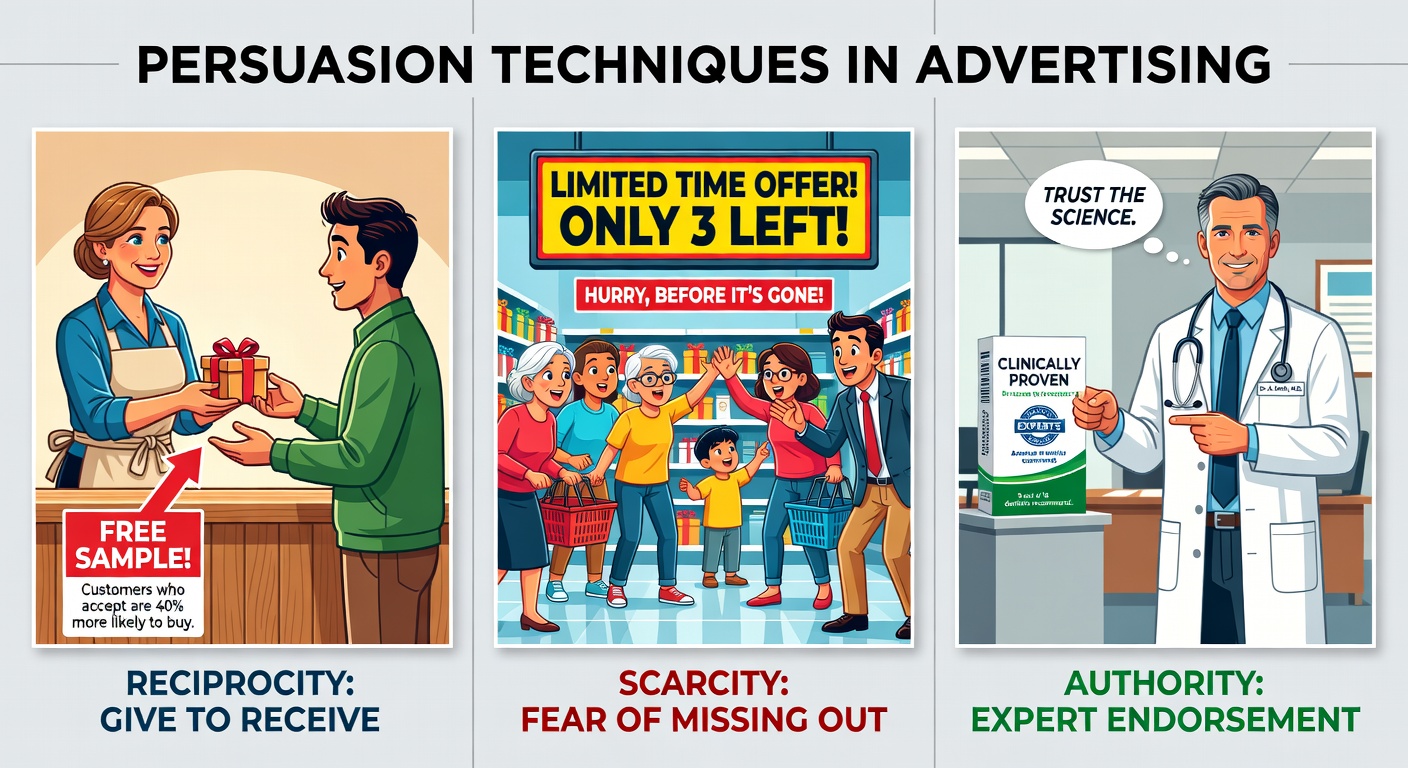
- Manufacturing false scarcity ("Only 3 left!" — for digital products)
- Fabricating social proof (fake subscriber counts, testimonials)
- Using fear to override rational decision-making for harmful products
- Exploiting confirmation bias to radicalize or distort audience worldviews
- Anchoring to fictional original prices
- Disguising promotional content as editorial
Avoiding Dark Patterns
The FTC, ASA, and equivalent consumer protection bodies worldwide are increasingly attentive to content and marketing practices that exploit cognitive biases deceptively. Beyond regulatory risk, there is a business case for ethical practice: audiences deceived by dark patterns do not become loyal communities — they become liabilities. Trust, once lost through perceived manipulation, is extraordinarily costly to rebuild.
Long-Term Risk: Research by Edelman (2024) found that 63% of consumers who discover they have been deliberately manipulated by content or marketing practices reduce or eliminate engagement with that brand entirely. The short-term gains from dark patterns are systematically outweighed by long-term trust destruction.
Responsible Use of Bias Knowledge
The most sustainable path is to use bias knowledge diagnostically and defensively: identify which biases your audience is already subject to in your category, and design content that helps them make better decisions rather than exploiting their cognitive shortcuts. Audiences who feel a creator genuinely serves their interests become the most loyal, most forgiving, and most valuable communities in the long run.
Key Takeaways
- Dual-process theory (Kahneman's System 1 and System 2) explains why most content decisions are made rapidly, emotionally, and with minimal deliberate reasoning — design for System 1 first.
- Confirmation bias is the most powerful algorithmic amplifier in digital media — understanding it is essential for both content creators and critical consumers of information.
- Anchoring shapes how audiences perceive value before they read a single word of body content — invest in deliberate anchor-setting in headers, bios, and opening lines.
- Loss aversion is the most consistently documented and reliable bias for CTA optimization — but its power is contingent on representing genuine losses, not manufactured ones.
- Ethical use of cognitive bias knowledge builds sustainable trust; dark patterns extract short-term gains at the cost of long-term community destruction.
Actionable Tips
Audit Your CTAs for Framing
Review every CTA in your content for gain vs. loss framing. A/B test loss-framed variants on your highest-traffic touchpoints and measure real conversion lift over 4 weeks.
Set Your Anchor Early
In every piece of content, establish the value anchor within the first 100 words: credentials, research depth, stakes, or social proof. Audiences judge everything that follows against this anchor.
Challenge Confirmation Bias Quarterly
Include at least one piece per quarter that constructively challenges your audience's dominant assumptions. This builds intellectual trust and resistance to the echo chamber dynamic.
Run a Dark Pattern Audit
Systematically review your content and conversion flows against a dark patterns checklist. Where you find manipulative elements, replace them with transparent, value-forward alternatives and measure the long-term retention impact.
References
- Kahneman, D. (2011). Thinking, Fast and Slow. Farrar, Straus and Giroux.
- Tversky, A., & Kahneman, D. (1974). Judgment under uncertainty: Heuristics and biases. Science, 185(4157), 1124–1131.
- Tversky, A., & Kahneman, D. (1981). The framing of decisions and the psychology of choice. Science, 211(4481), 453–458.
- Cialdini, R. B. (2021). Influence: The Psychology of Persuasion (New and Expanded). Harper Business.
- Matz, S. C., Segalin, C., & Bonneau, R. (2017). Psychological targeting as an effective approach to digital mass persuasion. PNAS, 114(48), 12714–12719.
- Rangel, A., Camerer, C., & Montague, P. R. (2008). A framework for studying the neurobiology of value-based decision making. Nature Reviews Neuroscience, 9(7), 545–556.
- Edelman (2024). Edelman Trust Barometer: Special Report on Digital Media. Chicago: Edelman Intelligence.
- Dunning, D., & Kruger, J. (1999). Unskilled and unaware of it. Journal of Personality and Social Psychology, 77(6), 1121–1134.
Think Smarter About Content Strategy
Our weekly research digest decodes the behavioral science behind what audiences actually do — not what they say they do. Join 12,000+ readers.