Attention is the gateway to all human experience. Before you can remember something, learn something, or be moved by something, you must first pay attention to it. For content creators, understanding how the brain allocates this precious, finite resource is not just interesting — it is essential.
What Is Attention in a Digital Context?
Attention, at its core, is a cognitive process by which the brain selectively concentrates on one aspect of the environment while ignoring other things. In a digital context, this translates to an extraordinarily competitive landscape: at any given moment, a user's screen may contain dozens of stimuli — notifications, thumbnails, headlines, motion, sound — all competing for the same limited pool of attentional resources.
Psychologists have identified several distinct types of attention, each with different implications for how content is consumed and remembered.
Selective Attention
The ability to focus on a specific stimulus while filtering out distractions. This is what allows a reader to absorb an article in a busy coffee shop.
Sustained Attention
Maintaining concentration over a prolonged period. Long-form video, podcasts, and serial fiction depend heavily on the audience's sustained attention capacity.
Divided Attention
Processing two or more streams simultaneously. Most social media scrolling occurs in a divided-attention state, which significantly reduces retention.
Executive Attention
Top-down, goal-directed focus that overrides automatic responses. Active learning and deliberate research rely on this higher-order attentional mode.
The 8-Second Myth
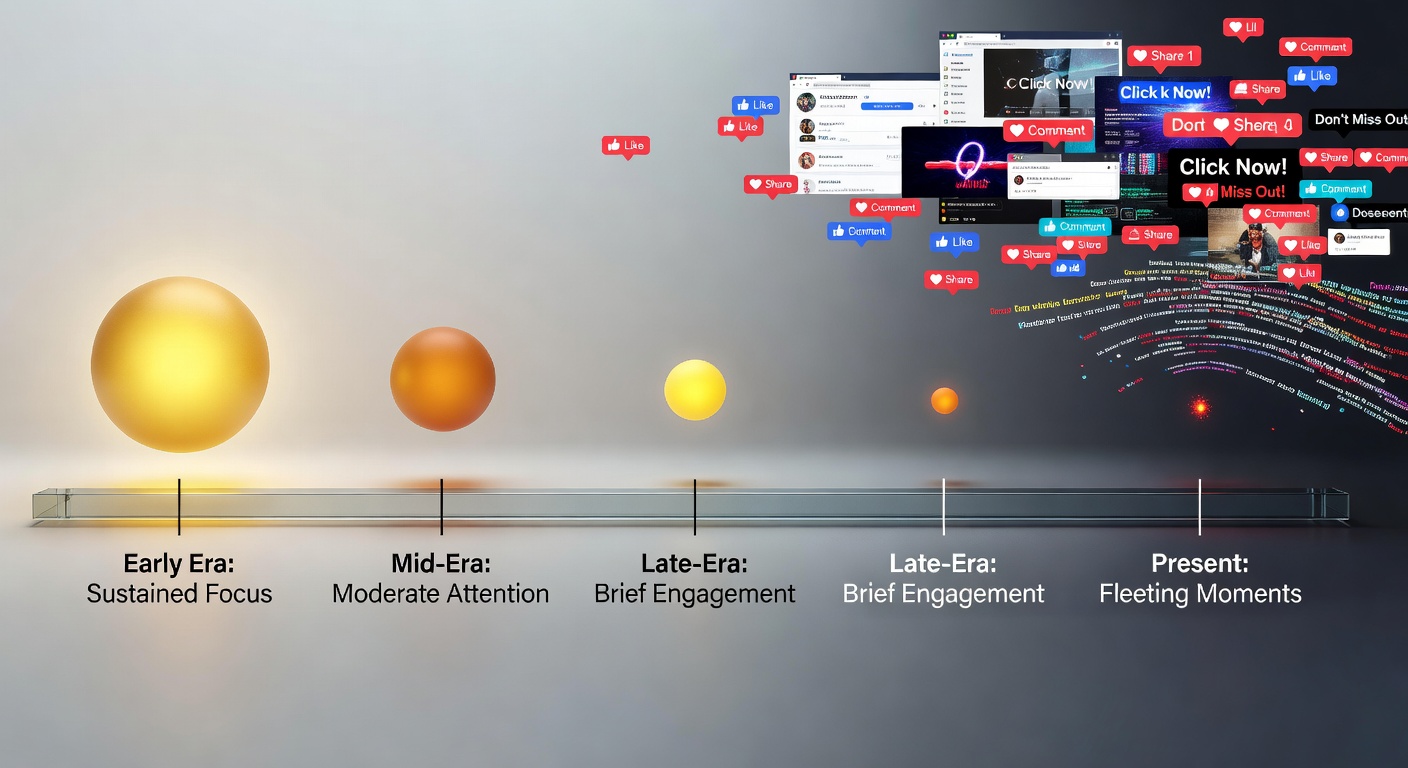
Perhaps no claim about digital behavior has been repeated more widely — or more wrongly — than the assertion that the average human attention span is eight seconds, shorter than that of a goldfish. This statistic, which circulated widely after a 2015 Microsoft Canada report, was never based on peer-reviewed science and has since been thoroughly debunked by researchers.
Myth vs. Reality
The claim: Human attention spans have shrunk to 8 seconds due to digital technology. The reality: Attention span is not a single, fixed trait. It varies dramatically by task, motivation, context, and individual. There is no credible evidence that our baseline attentional capacity has declined.
What research actually shows is more nuanced. A 2019 study by Gloria Mark at UC Irvine found that while people do switch screens frequently (roughly every 47 seconds on average), this is largely driven by environmental interruption and workplace norms rather than diminished cognitive capacity. When people are genuinely engaged, they sustain attention for far longer periods than eight seconds.
The practical implication for content creators: the problem is not that audiences cannot pay attention. The problem is that they will not pay attention unless there is a compelling reason to do so. The battle is for initial engagement, not for some diminished attentional ceiling.
Pattern Interruption: The Engine of Capture
The brain's default mode is prediction. At every moment, the prefrontal cortex is running predictive models of the environment, and when reality matches the model, attention is not required. This is why you can drive a familiar route without consciously processing it. Pattern interruption — introducing something unexpected or novel — forces the attentional system to activate.
Content creators exploit this principle constantly. Here are five core techniques:
-
01
The Disruptive Opening Beginning with a counterintuitive claim, a surprising statistic, or a provocative question. Example: "Everything you know about habit formation is probably wrong." Immediately violates prediction, demanding engagement.
-
02
Visual Pattern Breaks Sudden changes in visual rhythm — a full-bleed image in a text article, a jump cut in video, an unexpected color block — trigger the orienting reflex, automatically redirecting attention.
-
03
Tonal Shifts Abruptly changing from formal to conversational, from analytical to emotional, or from narrative to instructional. The brain flags the change as significant and re-engages.
-
04
Strategic Whitespace In long-form writing, a single short sentence after a dense paragraph creates dramatic contrast. The eye is drawn to it, and readers re-anchor their attention at that point.
-
05
The Open Loop Raising a question or beginning a story and deliberately delaying its resolution. The brain experiences this as a pattern that demands completion, sustaining attention until closure is provided.
Cognitive Load and Attention
Cognitive Load Theory, developed by educational psychologist John Sweller in the late 1980s, proposes that working memory — the system that actively processes incoming information — has a strictly limited capacity. When cognitive load exceeds this capacity, comprehension fails, learning breaks down, and critically, attention collapses.
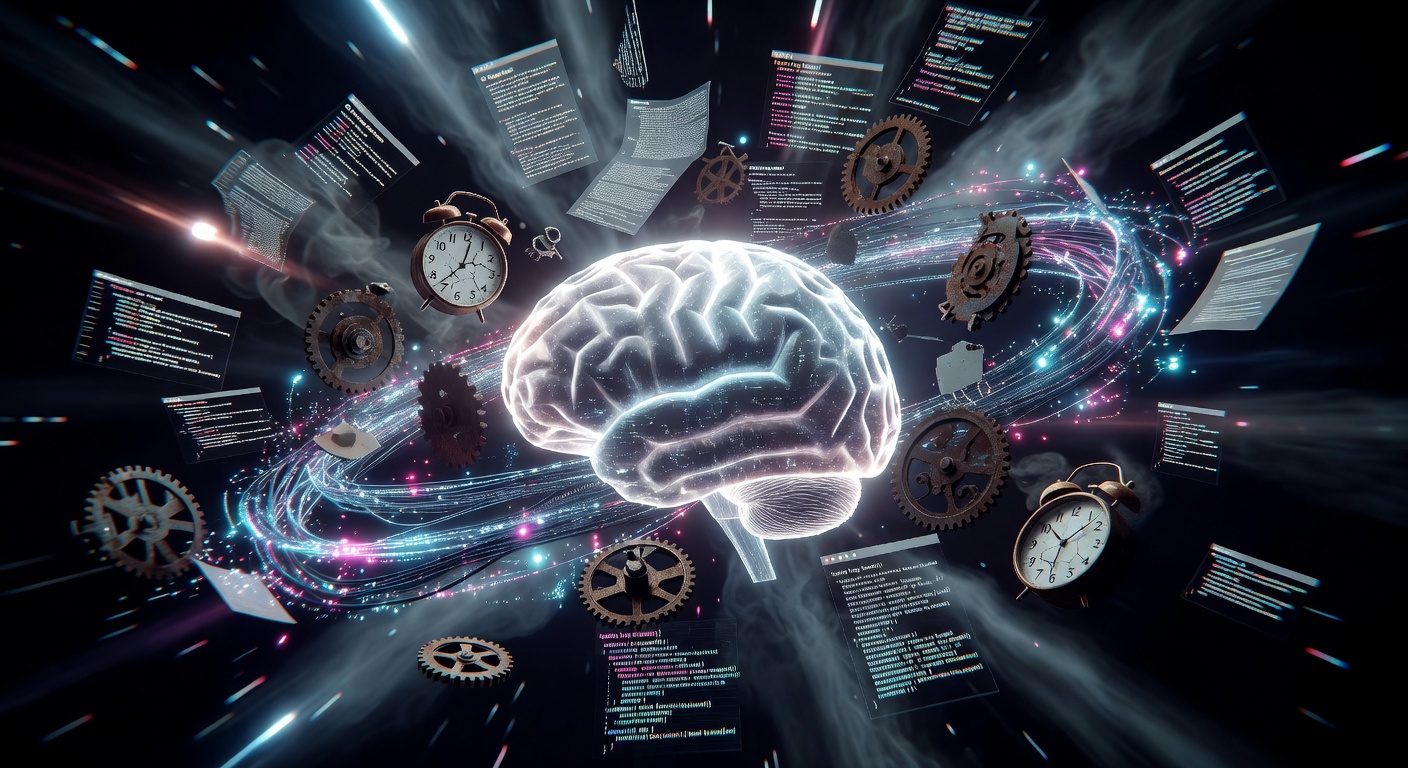
Sweller distinguished three types of cognitive load: intrinsic load (the inherent complexity of the material), extraneous load (load imposed by poor presentation or design), and germane load (cognitive effort directed toward actual learning and understanding).
For content designers, the actionable insight is that extraneous load is largely within your control. Cluttered layouts, excessive visual noise, inconsistent navigation, and poorly structured information all increase extraneous load — taxing working memory on tasks unrelated to understanding the content itself. Reducing this frees cognitive resources for genuine engagement.
Research by Paas and van Merriënboer (1994) demonstrated that spatial contiguity — placing explanatory text directly next to relevant visuals rather than in separate captions or legend boxes — significantly reduces split-attention effect, a specific form of extraneous cognitive overload common in instructional content.
The Cocktail Party Effect
In 1953, Colin Cherry described a phenomenon now known as the cocktail party effect: the ability to focus on a single conversation in a noisy room, while simultaneously and automatically monitoring other conversations for your own name or other personally relevant signals. This demonstrated that even "tuned-out" stimuli are processed at a basic level by a preattentive system.
In content feeds, the cocktail party effect explains why certain content consistently captures attention even in highly noisy, crowded environments. The preattentive system is scanning for: your name or identity-relevant categories, strong emotional signals (threat, disgust, arousal), high-contrast visual stimuli, and movement. Content that triggers these preattentive filters bypasses the conscious filter entirely and forces attention allocation before any deliberate choice is made.
This is why thumbnail design, headline emotional valence, and the first frame of a video are disproportionately important. They are not competing with conscious evaluation — they are competing for preattentive capture, which happens in under 200 milliseconds.
F-Pattern and Z-Pattern Reading
Decades of eye-tracking research have established predictable patterns in how people visually scan digital content. Understanding these patterns is foundational to structuring content for maximum attention and retention.
F-Pattern Reading
Originally documented by Nielsen Norman Group, the F-pattern describes how readers of text-heavy pages typically make two horizontal passes across the top of the content, then shift to vertical scanning down the left side of the page. Critical information should be front-loaded in the first line, and subsequent paragraph openings must carry independent meaning for readers who will not complete each sentence.
Z-Pattern Scanning
More common on visually balanced pages and landing pages with sparse text, the Z-pattern follows the natural reading direction: top-left to top-right, then diagonally to bottom-left, then across to bottom-right. Page elements placed at Z-pattern anchor points — especially top-left (brand/logo) and bottom-right (CTA) — receive maximum fixation time.
More recent research has added nuance. Bojko (2013) documented layer-cake patterns, spotted patterns, and commitment patterns alongside F and Z, suggesting that reading behavior is more variable than early studies implied. The practical implication is that the first line or two of every paragraph must earn the reader's decision to continue — because many will not.
Key Takeaways
- Attention is not a single, fixed resource — it encompasses selective, sustained, divided, and executive modes, each relevant to different content formats.
- The "8-second attention span" claim is not supported by science. Engagement depth depends on relevance and motivation, not a biological ceiling.
- Pattern interruption — novelty, disruptive openings, tonal shifts — exploits the brain's prediction system to force attentional activation.
- Reducing extraneous cognitive load through clean design and clear structure directly increases the attentional resources available for content itself.
- F and Z-pattern scanning mean that the first words of headlines and paragraph openings carry disproportionate weight in capturing and sustaining readership.
Apply These Principles
Front-load your value
Place the core payoff of your content — the insight, the surprise, the usefulness — in the first 100 words. Do not "bury the lede." Audiences decide whether to continue within seconds of landing.
Audit your cognitive load
Review your content layout for extraneous complexity. Remove unnecessary navigation elements, use consistent visual language, and ensure explanatory text is adjacent to relevant visuals.
Install pattern interrupts every 300 words
In long-form writing, use visual breaks, pull quotes, numbered lists, or short single-sentence paragraphs every few hundred words to reset attentional engagement.
Write for scanners, reward readers
Structure content so that paragraph openings, headings, and visual callouts tell a complete story for the F-pattern scanner — while the full text rewards those who commit to reading in full.
Stay Ahead of the Research
Get weekly evidence-based insights on content psychology, behavioral science, and audience engagement — straight to your inbox.
References
- Cherry, E. C. (1953). Some experiments on the recognition of speech, with one and with two ears. Journal of the Acoustical Society of America, 25(5), 975–979. https://doi.org/10.1121/1.1907229
- Mark, G., Iqbal, S., Czerwinski, M., & Johns, P. (2014). Capturing the mood: Facebook and face-to-face encounters in the workplace. Proceedings of the ACM Conference on Computer Supported Cooperative Work & Social Computing, 1082–1094.
- Paas, F. G. W. C., & van Merriënboer, J. J. G. (1994). Variability of worked examples and transfer of geometrical problem-solving skills: A cognitive-load approach. Journal of Educational Psychology, 86(1), 122–133.
- Sweller, J. (1988). Cognitive load during problem solving: Effects on learning. Cognitive Science, 12(2), 257–285. https://doi.org/10.1207/s15516709cog1202_4
- Nielsen, J., & Pernice, K. (2010). Eyetracking web usability. New Riders Press.
- Bojko, A. (2013). Eye tracking the user experience: A practical guide to research. Rosenfeld Media.
- Lavie, N. (2005). Distracted and confused?: Selective attention under load. Trends in Cognitive Sciences, 9(2), 75–82. https://doi.org/10.1016/j.tics.2004.12.004